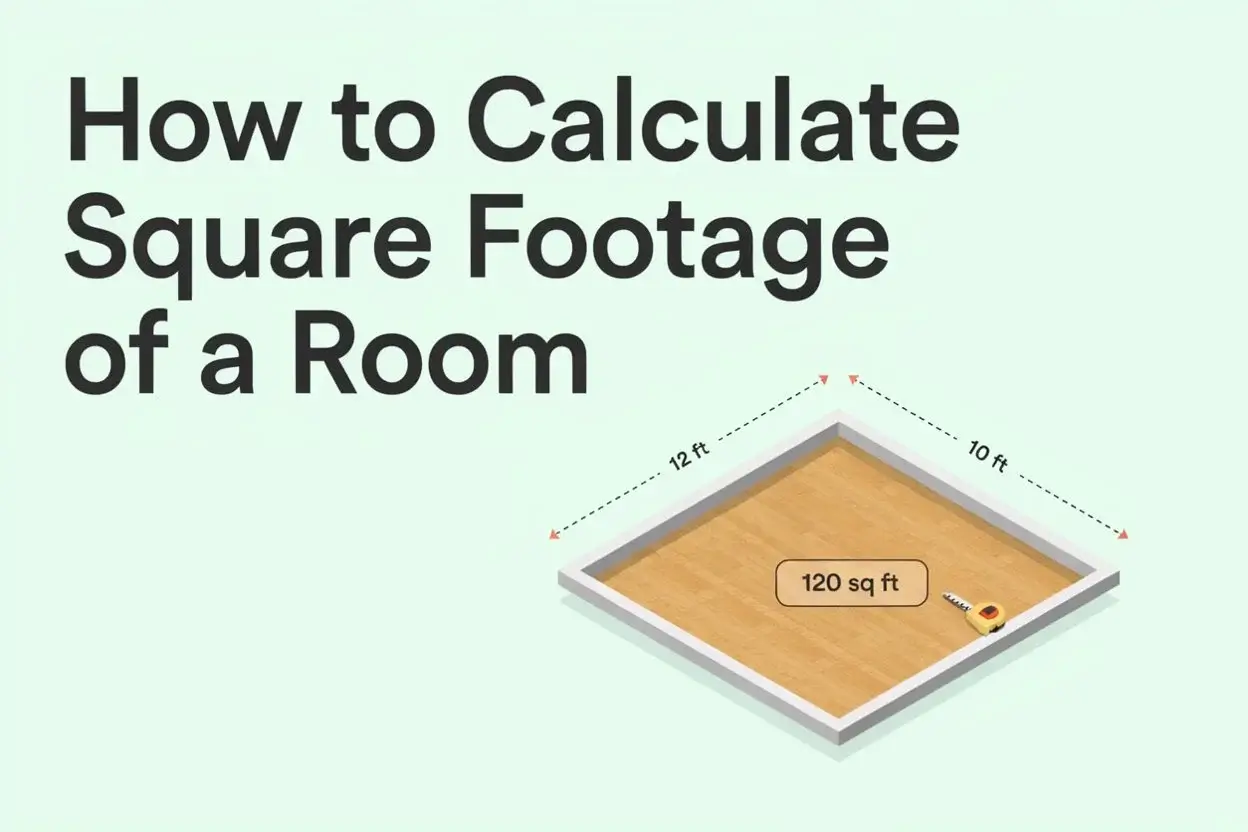
How to Calculate Square Footage of a Room
Calculating square footage takes about two minutes and saves you from buying 300 square feet of flooring for a 200 square foot room. Here’s everything you need — the formula, the shortcuts, and what to do when rooms aren’t a clean rectangle.
Whether you’re planning new floors, estimating paint, figuring out if that sectional couch fits, or just comparing rental listings — square footage is the number you need. Let’s get it right the first time.
Want the result instantly? Use our free Square Foot Calculator to calculate room area in seconds.
What Is Square Footage?
One square foot is a patch of floor exactly 1 foot wide and 1 foot long — picture a floor tile that’s 12 inches by 12 inches. Square footage is just a count of how many of those tiles fit inside your space.
You’ll use it for:
The Formula
For any rectangular room, it’s one multiplication:
Step-by-Step Instructions
15 × 12 = 180 sq ft
Common Room Sizes at a Glance
Not sure if your number is reasonable? Here’s a quick reference for typical room dimensions:
| Room Dimensions | Square Footage | Typical Use |
|---|---|---|
| 10 × 10 | 100 sq ft | Small bedroom, home office |
| 10 × 12 | 120 sq ft | Average bedroom |
| 12 × 12 | 144 sq ft | Standard bedroom |
| 12 × 15 | 180 sq ft | Large bedroom, small living room |
| 14 × 16 | 224 sq ft | Master bedroom |
| 15 × 15 | 225 sq ft | Medium living room |
| 16 × 20 | 320 sq ft | Large living room |
| 20 × 20 | 400 sq ft | Open-plan living area |
When Your Measurement Includes Inches
Most rooms don’t land on a clean foot. A room that measures 10 feet 6 inches by 12 feet 3 inches needs one extra step before you multiply.
→ Convert: 10.5 ft × 12.25 ft
10.5 × 12.25 = 128.6 sq ft
A quick trick to remember: divide the inch portion by 12 to get the decimal. 9 inches ÷ 12 = 0.75 ft. 6 inches ÷ 12 = 0.5 ft. Simple as that.
L-Shaped and Irregular Rooms
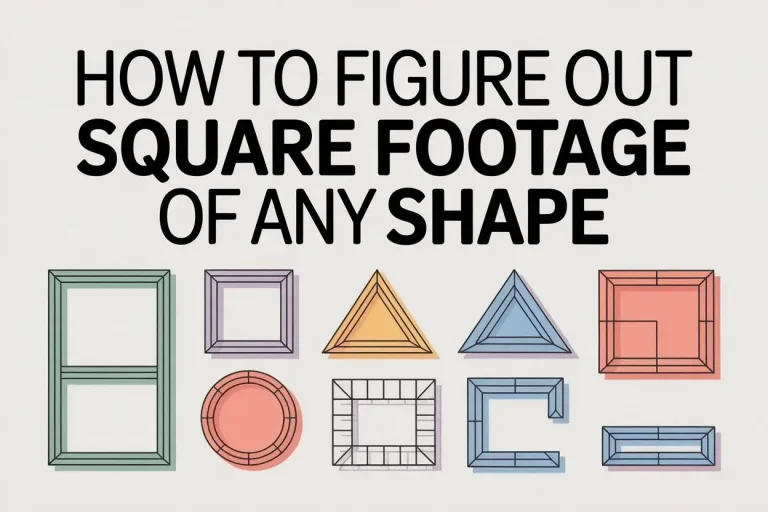
Not every room is a clean rectangle. For L-shaped rooms or rooms with alcoves and bump-outs, split the space into two rectangles, calculate each one separately, then add them together. The same logic works for any shape — just keep breaking it into rectangles.
L-Shaped Room
Draw a line to cut the room into two clean rectangles. Measure each one. Add them together. The dividing line can go anywhere that makes the two rectangles easy to measure — pick whatever works for your room shape.
Section B: 5 × 8 = 40 sq ft
120 + 40 = 160 sq ft
Flooring: How Much to Buy
Raw square footage is the floor area. Flooring, tile, and carpet need a bit more because cuts waste material. How much extra depends on the complexity of the job:
144 × 1.10 = 158.4 sq ft → Buy for 160 sq ft (round up to full boxes)
Always buy full boxes — most flooring comes in fixed carton sizes and you can’t purchase half a box. Round up, not down. Running short mid-install means a second trip and possibly a different dye lot that won’t match.
Use SquareFootCalc.com to calculate area and add the waste percentage automatically.
Painting Walls: A Different Calculation
Wall square footage is different from floor square footage — you’re measuring vertical surfaces, not the floor. The approach changes slightly:
Mistakes Worth Avoiding
A room listed as “about 12 feet” might actually be 11 ft 9 in. On a 150 sq ft room, that gap can throw you off by 10–15 sq ft — enough to run short on flooring.
Walls aren’t always perfectly parallel. Measure at both ends of each wall and use the larger number to be safe — especially in older homes where walls can bow or angle slightly.
Do your math with the full decimal, then round only at the final step. Rounding 0.666 to 0.7 early in the calculation compounds into a bigger error at the end.
If you’re buying flooring, the closet floor needs it too. Measure it separately and add it to your total — a typical 3 × 5 ft closet is 15 sq ft you’d otherwise miss.
Always buy extra. The 5–15% rule isn’t padding for its own sake — cuts leave offcuts, patterns need alignment, and mistakes happen. Too little means a second trip and possibly a different dye lot.
Measure to the outermost point and treat it as a rectangle. You’ll slightly overestimate — which is actually fine for material purchases, since you want a little extra anyway.
Frequently Asked Questions
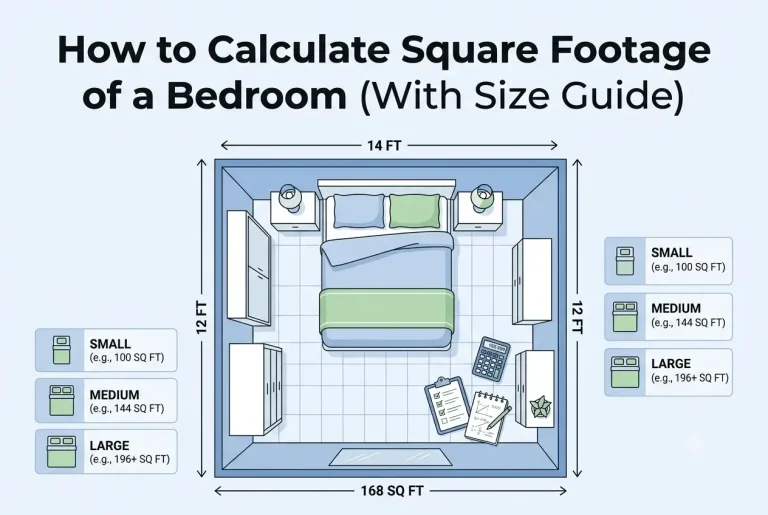
144 square feet. 12 × 12 = 144. A very common bedroom size.
100 square feet. 10 × 10 = 100. This is considered a small bedroom or a compact home office.
12 × 14 = 168 square feet. Same formula: length × width.
Yes — measure both walls in inches, multiply them together, then divide by 144 to convert to square feet. (There are 144 square inches in one square foot.) For example: 126 inches × 144 inches = 18,144 ÷ 144 = 126 sq ft.
Measure to the outermost point and treat the whole space as a rectangle. You’ll slightly overestimate the area — which is fine for material purchases since you want a buffer anyway. For a precise measurement, break the bay window into a separate rectangle or half-circle and add it to the main room.
For flooring: yes — the closet floor needs covering too, so measure it separately and add it to your total. For real estate comparisons: closets are typically included in a room’s stated square footage. For renovation quotes: mention it specifically so contractors know to account for it.
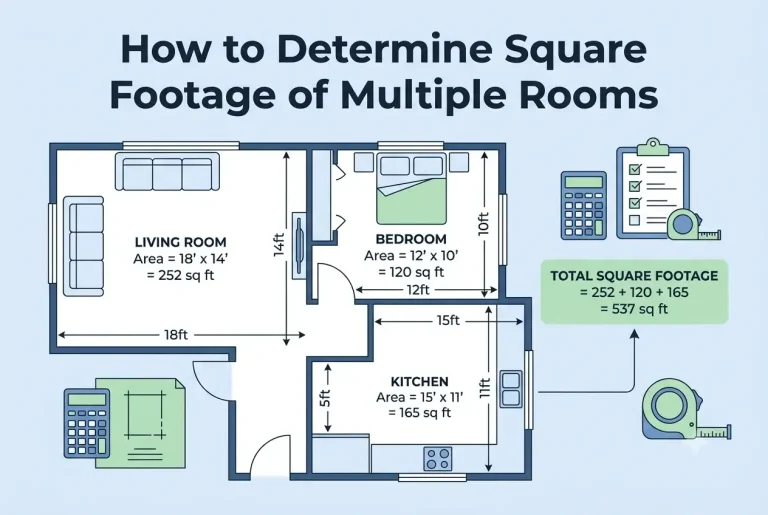
Calculate each room separately using length × width, then add all the totals together. Our free Square Foot Calculator lets you enter multiple areas and combines them automatically.
Once you’ve measured length and width, the math takes seconds. Want to skip even that?
Calculate Square Footage Free →
Who Luke?
Luke has spent years working around home renovation and construction projects, which is where his obsession with getting measurements right started. One wrong square footage estimate can mean hundreds of dollars wasted on flooring or materials — he learned that the hard way. These days he writes practical guides to help homeowners, renters, and DIYers measure accurately and confidently without needing a contractor to hold their hand.