How to Figure Out Square Footage of Any Shape
A practical, formula-by-formula guide to measuring rooms, floors, and land — from simple rectangles to awkward L-shaped layouts with closets tucked into corners.
Most rooms aren’t complicated, and yet measuring them wrong is surprisingly common. You tape the long wall, tape the short wall, multiply — and end up buying flooring that either runs out three rows short or sits in a dusty pile in your garage for a decade.
The culprit is usually a shape you didn’t account for: a bay window bump-out, a triangular corner, a closet you mentally added wrong. This guide walks through every shape you’re likely to encounter, with the exact formula and a worked example for each one.
What Square Footage Actually Means
One square foot is a square that’s one foot on each side — 12 inches by 12 inches. Square footage is just a count of how many of those squares fit inside your space.
That’s it. The formulas below are just different ways to count those squares depending on the shape you’re working with. A rectangle gives you an easy grid count. A triangle is half a rectangle. A circle is where it gets a little more interesting, but nothing you need calculus for.
Formulas by Shape
Rectangle & Square
The building block of almost every measurement. Measure the longest wall (length), then the adjacent wall (width), multiply. For a square room, both dimensions are the same.
12 × 15 = 180 sq ft
Triangle
The height is the perpendicular distance from the base to the opposite point — not the length of a slanted side. That’s the part people get wrong most often.
½ × 10 × 8 = 40 sq ft
Circle
The radius is half the diameter — measure straight across the widest point and divide by two. If you only have the diameter, use: Area = π × (d/2)².
π × 6² = 3.14159 × 36 = 113.1 sq ft
Trapezoid
Where a is the top side, b is the bottom side, and h is the perpendicular height between them. Think of it as averaging the two parallel sides, then multiplying by the height.
½ × (8 + 12) × 10 = 100 sq ft
L-Shaped Room
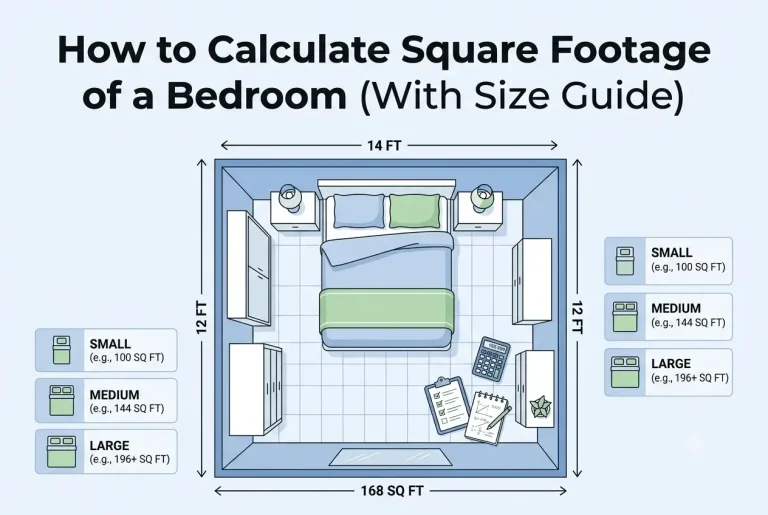
Draw a line to cut the room into two rectangles. Measure each one separately. Add them together. The tricky part is deciding where to draw that dividing line — pick wherever makes the two rectangles cleanest to measure.
Section B: 6 × 8 = 48 sq ft
120 + 48 = 168 sq ft
Measuring Rooms That Don’t Fit a Formula
Bay windows, angled walls, curved spaces, rooms with closets punched into corners — these don’t have a single formula. But they all break down the same way.
Example: An Irregular Room with a Corner and a Closet
Irregular Floor Plan
Each section measured and calculated separately, then added together.
Bay triangle: ½ × 6 × 4 = 12 sq ft
Closet: 3 × 5 = 15 sq ft
168 + 12 + 15 = 195 sq ft
Adding a Waste Factor for Flooring
Raw square footage gets you to the starting line. Flooring, tile, and carpet require a bit more because cuts waste material. How much more depends on layout complexity:
For that 195 sq ft room: at 10% overage, you’d buy material for 215 sq ft. Buy full boxes — most flooring comes in fixed-size cartons and you can’t purchase half a box.
For fast and accurate results, use SquareFootCalc.com and calculate square footage of any shape in seconds.
Quick Reference
| Shape | Formula | What to Measure |
|---|---|---|
| Rectangle | L × W | Length and width |
| Square | Side² | One side only |
| Triangle | ½ × b × h | Base and perpendicular height |
| Circle | π × r² | Radius (half the diameter) |
| Trapezoid | ½ × (a + b) × h | Both parallel sides and height |
| L-shaped room | A₁ + A₂ | Split into rectangles, measure each |
| Irregular shape | Sum of sections | Break into simple shapes, add all |
Mistakes That Cost You Money
For triangles and trapezoids, height is always the perpendicular distance — straight up and down, not along a diagonal edge.
Closets, alcoves, and bay windows add up. A 3×5 closet is 15 sq ft — roughly one box of flooring you forgot to account for.
Round only the final number. Rounding 11.75 ft to 12 ft, then again to a round number, compounds the error.
Buying exactly what the room measures means you’ll run short. Always add at least 5–10% for cuts and damage.
Rooms aren’t always perfectly square. Measure opposite walls both ways — if they’re more than an inch off, average them.
Eyeballing a bay window as “about a rectangle” will be off. For any curved section, find the radius and use the circle formula on just that arc.
Frequently Asked Questions
Measure both pairs of opposite walls and average each pair. So if one wall is 11’8″ and the opposite is 12’2″, use 11’11” as your length. It’s not perfect, but it’s far better than picking one and hoping.
For flooring purposes: not always. Most flooring doesn’t run under fixed cabinetry (like a kitchen island bolted to the floor). For room comparison or real estate purposes, the convention is to measure wall-to-wall including those areas. Clarify which purpose you’re measuring for.
Treat it as a rectangle minus the triangle that was cut off. Measure the full rectangle the room would be if that corner weren’t cut, calculate it, then calculate the area of the cut triangle and subtract it.
If it’s a rectangular bay, measure length and depth as a separate rectangle. If it curves, measure the radius of the curve and use the circle sector formula — that’s π × r² × (angle / 360). For a typical 180° curved bay, that’s half a circle: π × r² / 2.
For flooring: yes, you need to cover that floor. For real estate listings, practices vary by region — some include closets, some don’t. If you’re comparing rooms or listings, make sure you know which convention is being used.

Who Luke?
Luke has spent years working around home renovation and construction projects, which is where his obsession with getting measurements right started. One wrong square footage estimate can mean hundreds of dollars wasted on flooring or materials — he learned that the hard way. These days he writes practical guides to help homeowners, renters, and DIYers measure accurately and confidently without needing a contractor to hold their hand.