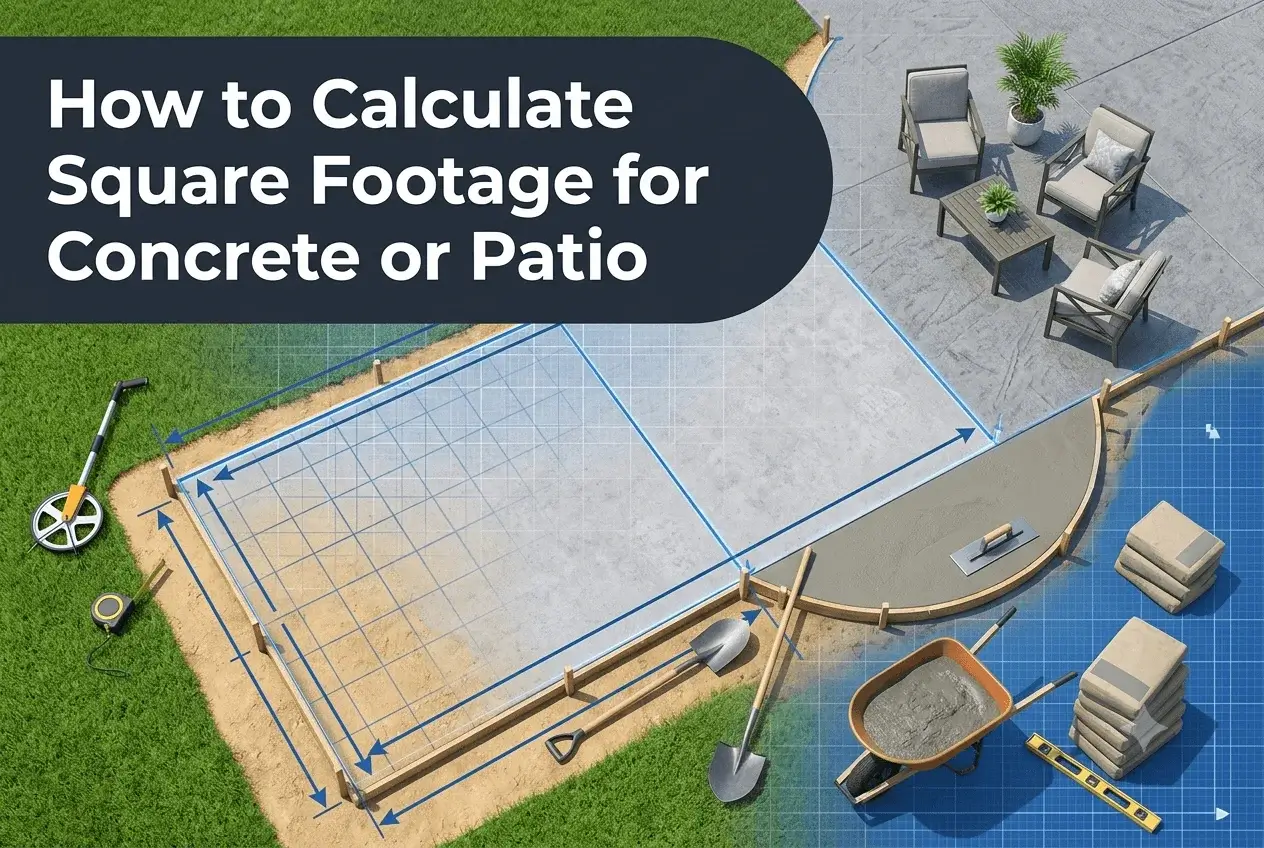
How to Calculate Square Footage for Concrete or Patio
Concrete is the one material on this list that isn’t sold by area at all — it’s sold by volume, and area is only half the equation. Forget the depth of the pour and you can calculate a flawless square footage and still order the wrong amount of concrete, because a 4-inch patio and an 8-inch driveway need completely different quantities from the same footprint. Here’s how the math actually works.
Every other material in this series is calculated in two dimensions — length and width. Concrete adds a third: depth. That third dimension is why concrete is priced and delivered by the cubic yard, not the square foot, and why getting the depth wrong throws off the whole order even when the footprint is measured perfectly.
Have your slab’s length and width ready? Use SquareFootCalc.com to get the footprint in square feet, then apply the depth conversion in this guide.
The Formula
Add 5–10% waste, then round UP to the nearest quarter yard
Step-by-Step Process
Concrete Thickness — How Depth Changes Everything
The same 240 sq ft patio needs a completely different concrete order depending on whether it’s a walkway or a driveway meant to carry a truck. Depth isn’t a detail to check later — it’s the second half of the formula, and skipping it is the most common way concrete orders go wrong.
Simple Rectangular Slabs
10% as a safer default, covering over-excavation and minor spillage
Square slabs waste the least concrete because there’s no irregular edge to overpour. Most of the buffer here covers the base excavation running slightly deeper than planned, plus what’s left in the chute and wheelbarrow after the pour.
2.93 × 1.10 = 3.22
→ Order 3.25 cu yd
Irregular and Curved Patios
15% for tight curves, multiple radii, or a shape with several distinct sections
Break the shape into rectangles and approximate any curves as their bounding rectangle, then calculate each section’s volume separately and add them together. The extra waste covers the curved edge, where formwork rarely matches the concrete’s actual footprint exactly.
3.42 × 1.12 = 3.83
→ Order 4 cu yd
Footings and Walls
Footing width and depth are usually set by local code, not chosen freely
Footings run in a line rather than covering an area, so the calculation swaps length × width for linear footage × cross-section. Check your local building code for required footing dimensions before ordering — they’re typically non-negotiable for structural work like a foundation or a fence post line.
1.97 × 1.10 = 2.17
→ Order 2.25 cu yd
Pavers — A Different Calculation Entirely
Pavers aren’t poured, so they don’t use cubic yards at all — they’re sized and counted the same way as tile, with a gravel and sand base underneath instead of a concrete slab.
Base material: patio sq ft × base depth (in ft, typically 4–6 in) ÷ 27 = cubic yards of gravel
A paver patio means two purchases: the pavers themselves (counted like tile) and the gravel base beneath them (calculated in cubic yards like concrete, just with crushed stone instead of ready-mix). Don’t let one calculation stand in for the other — they use different formulas and different suppliers.
Worked Examples by Project
3×20 ft walkway, 3.5 in slab
12×16 ft patio, 4 in slab
16×40 ft driveway, 5 in slab
10×12 ft shed pad, 4 in slab
Quick Reference Table
| Slab Size | 4 in Depth | 5 in Depth | 6 in Depth |
|---|---|---|---|
| 10 × 10 ft | 1.25 cu yd | 1.6 cu yd | 1.9 cu yd |
| 10 × 20 ft | 2.5 cu yd | 3.15 cu yd | 3.75 cu yd |
| 12 × 16 ft | 2.75 cu yd | 3.4 cu yd | 4.1 cu yd |
| 16 × 40 ft (driveway) | 8.8 cu yd | 10.75 cu yd | 13.2 cu yd |
Figures include a 10% waste allowance and are rounded to the nearest quarter yard, the standard increment for ready-mix delivery.
Mistakes to Avoid
Calculating only length × width gives you a footprint, not an order. Concrete is a volume — depth is not optional information, it’s half the formula.
Depth is almost always specified in inches but needs converting to feet before it goes into the formula. Forgetting to divide by 12 overstates your order by roughly 12 times.
Most ready-mix trucks have a minimum order, often around 1 cubic yard. A small project that calculates to 0.6 cubic yards still needs to round up to the truck’s minimum, not down to what’s “needed.”
Footings and structural pours often have a legally required minimum depth that has nothing to do with the slab above them. Check local code before finalizing that part of the order.
Running short mid-pour means a cold joint where the new batch meets the old — a visible seam and a weak point in the slab. Round up, not down, every time.
Paver patios need their own base-material order calculated separately from the paver count. Skipping this step means a delayed project once the crew realizes there’s nothing to set the pavers on.
Frequently Asked Questions
At a standard 4-inch depth: 100 sq ft × 0.33 ft = 33 cu ft, divided by 27 = 1.22 cu yd. Adding 10% waste brings it to 1.34, which rounds up to 1.5 cubic yards for delivery.
Multiply your square footage by the depth in feet (inches divided by 12) to get cubic feet, then divide by 27 to get cubic yards. Square footage alone isn’t enough — depth has to be part of the calculation.
4 inches is the standard thickness for a residential patio under normal foot traffic. Driveways typically need 4–5 inches for passenger vehicles, and 6–8 inches if the driveway will regularly carry trucks or RVs.
5–10% for a simple rectangular slab, 10–15% for irregular or curved shapes. Ready-mix trucks also have a minimum order, often around 1 cubic yard, so small projects may need to round up beyond their calculated waste factor just to meet that minimum.
No. Pavers are counted by piece, calculated the same way as tile — area divided by the paver’s individual square footage, plus a waste factor for cuts. The gravel base underneath the pavers is calculated separately, in cubic yards, similar to how concrete itself is ordered.
A cold joint is the visible seam that forms when one batch of concrete starts setting before the next batch is poured against it. It’s both a cosmetic flaw and a weak point in the slab. Ordering enough concrete to complete the pour in one continuous batch is the main way to avoid it.
Have your slab dimensions? Get the square footage instantly.
Calculate Square Footage Free →
Who Luke?
Luke has spent years working around home renovation and construction projects, which is where his obsession with getting measurements right started. One wrong square footage estimate can mean hundreds of dollars wasted on flooring or materials — he learned that the hard way. These days he writes practical guides to help homeowners, renters, and DIYers measure accurately and confidently without needing a contractor to hold their hand.