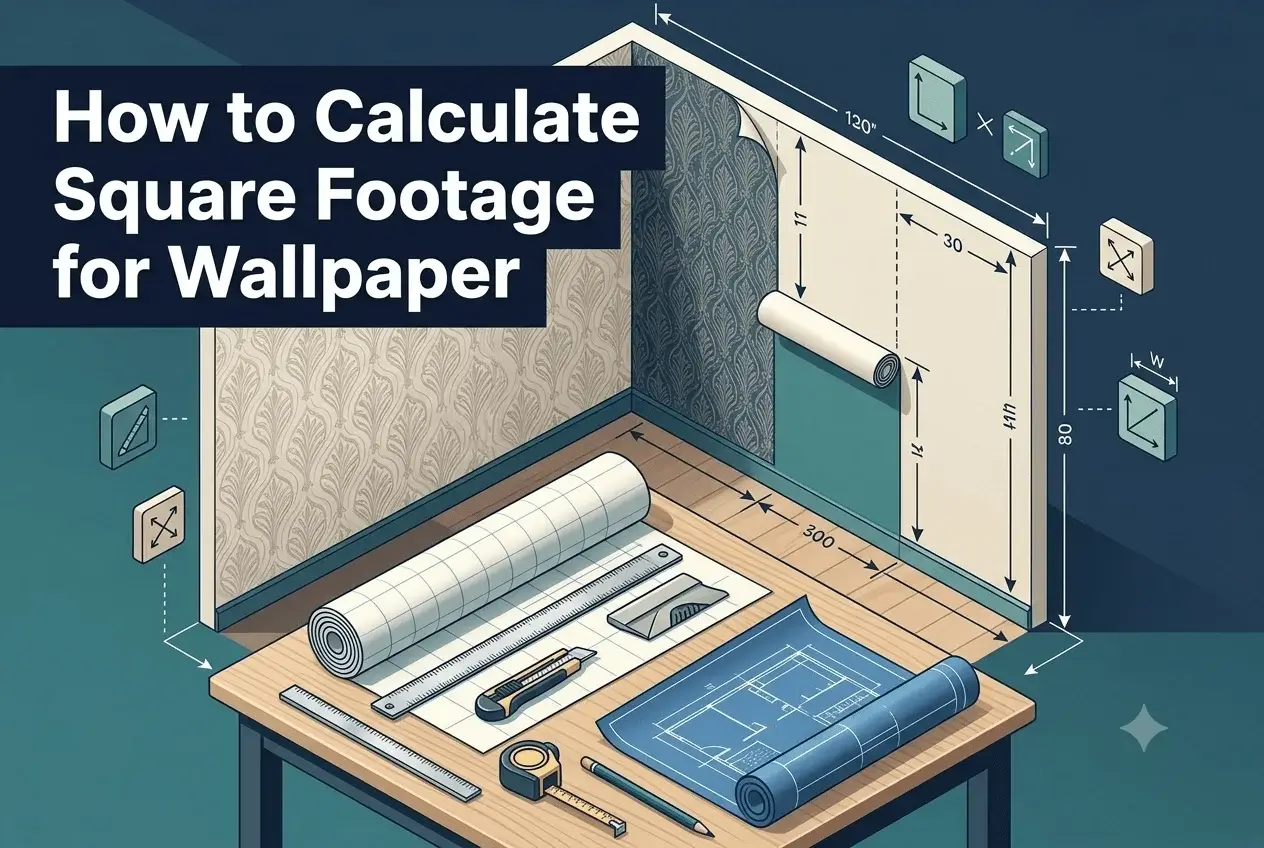
How to Calculate Square Footage for Wallpaper
Wallpaper waste doesn’t come from the room’s shape — it comes from the pattern. Every repeat has to line up strip after strip, which means offcuts you can’t reuse and rolls you have to buy in whole numbers, not fractions. Underestimate the repeat and you’ll be short a roll from a print run that’s already sold out. Here’s how to get the count right.
Wallpaper calculation shares the wall-area math you’d use for paint, but it adds a variable paint doesn’t have: pattern repeat. A plain grasscloth and a large-scale floral cost the same per roll but need completely different waste allowances, because every repeat forces you to shift the next strip up or down and trim off what doesn’t align.
Have your room dimensions ready? Use SquareFootCalc.com to get your wall area in seconds, then apply the roll coverage and waste factor from this guide.
The Formula
Round UP to the nearest whole roll — always buy from one dye lot
Step-by-Step Process
Measuring Wall Area and Subtracting Openings
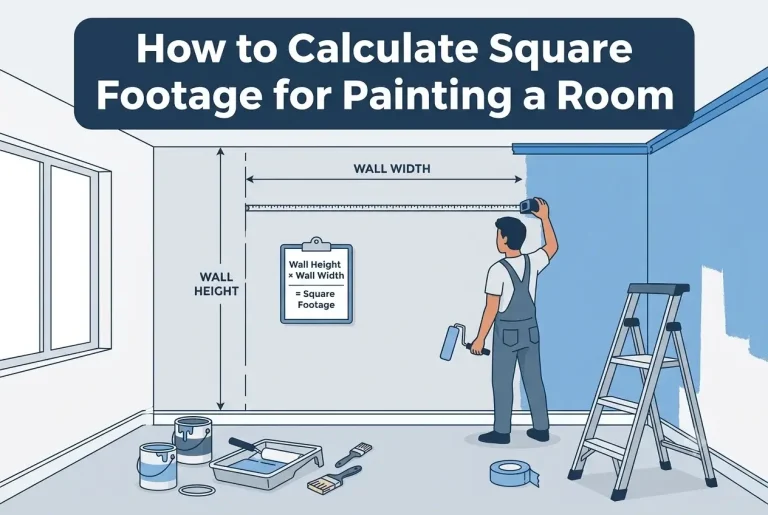
Wallpaper starts from the exact same wall-area calculation as paint: perimeter times height, minus doors and windows. The difference shows up later, in how the material comes off the roll in fixed-width, fixed-pattern strips rather than spreading evenly like liquid paint.
Subtract openings: door ≈ 20 sq ft, window ≈ 15 sq ft, large mirror or built-in ≈ 10–15 sq ft
Outlets, switches, and small wall fixtures aren’t worth subtracting — the strip still has to be cut to run past them, so the material gets used either way. Save the subtraction for openings large enough to skip an entire strip, like doors, windows, and built-in shelving.
Roll Sizes — American vs European
Wallpaper isn’t sold in a single global standard, and the roll’s printed length overstates what actually reaches your wall. Trimming for straight edges and shifting for pattern match both cut into the usable total.
Plain and Textured Wallpaper
Strips can be cut and hung in any order without matching a design across the seam
Solid colors and non-directional textures are the closest thing to a plain-paint calculation you’ll get with wallpaper. The waste is just trim at the ceiling line and baseboard, plus the standard buffer for a miscut strip here and there.
132 ÷ 26 (grasscloth usable) = 5.1
→ Buy 6 rolls
Straight Match Patterns
18% if the repeat runs 12–20 inches
Every strip lines up motif-to-motif with the one beside it, at the same height. The waste comes from trimming each new strip so its pattern starts at the right point — the offcut at the top of most strips is too short to reuse anywhere else on the wall.
345 ÷ 30 = 11.5
→ Buy 12 rolls
Drop Match Patterns
25% for a large-scale drop repeat (20 in or more)
Half the strips in a drop match start partway into the repeat, which means those strips lose more to the trim than a straight match ever does. Large florals and damasks are usually drop match — check the manufacturer’s spec sheet for the exact repeat measurement before calculating.
112.5 ÷ 30 = 3.75
→ Buy 4 rolls
Large-Scale Murals and Panels
The image is already sized and split into panels to fit your exact wall before it’s printed
Murals flip the usual process: you give the supplier your wall’s exact width and height, and the image is scaled and split into panels to match — there’s no pattern repeat to align because there’s only one continuous image. The small waste allowance covers trim at the ceiling and floor line, plus a margin for a panel that doesn’t sit perfectly plumb.
→ Confirm exact panel count with the supplier’s layout tool
Worked Examples by Room
12×11 ft, 8 ft ceiling, plain textured paper
14×12 ft, 9 ft ceiling, straight match pattern
6×5 ft, 8 ft ceiling, drop match, no windows
10×8 ft single wall, 9 ft ceiling, drop match
Quick Reference Table
| Room Size | Net Wall Area (approx.) | Plain (10%) | Straight Match (15%) | Drop Match (20–25%) |
|---|---|---|---|---|
| 10 × 10 ft | 270 sq ft | 10 rolls | 11 rolls | 12 rolls |
| 12 × 11 ft | 318 sq ft | 12 rolls | 13 rolls | 14 rolls |
| 14 × 12 ft | 400 sq ft | 15 rolls | 16 rolls | 17 rolls |
| Single accent wall (10×9 ft) | 90 sq ft | 4 rolls | 4 rolls | 4 rolls |
Figures assume 30 sq ft usable coverage per single roll. Adjust for your specific roll’s listed coverage and repeat size.
Mistakes to Avoid
A roll listed at 56 sq ft doesn’t put 56 sq ft on the wall — trim and pattern matching bring usable coverage down to roughly 28–30 sq ft. Calculating off the label number will leave you short.
Drop match patterns need a noticeably higher waste factor. Using a straight-match number on a drop-match paper is one of the most common reasons installers run short mid-room.
Every roll needs to come from the same production run. Ordering rolls separately over time, or buying “just one more” from a different batch, risks a visible color shift across the wall.
Doors, windows, and built-ins should come out of your gross wall area before you apply the waste factor. Skipping this step overstates your roll count and your budget.
Wallpaper patterns get discontinued more often than paint colors. If a pattern is limited-run, order a spare roll upfront — reordering later may not be possible at all.
If your calculation lands at 15.3 rolls, buy 16. A short order mid-installation means a delay while you wait on a reorder, plus the same dye-lot risk all over again.
Frequently Asked Questions
With an 8 ft ceiling: perimeter is 48 ft, gross wall area is 384 sq ft. Subtracting typical openings (35 sq ft) leaves 349 sq ft net. At 15% waste for a straight match pattern: 349 × 1.15 = 401 sq ft, divided by 30 sq ft usable per roll = about 14 rolls.
Straight match means the pattern repeats at the same height on every strip, so motifs line up in a straight horizontal row. Drop match means the pattern on alternating strips shifts down by half the repeat, creating a more organic look but wasting more material at the top of every other strip.
10% for plain or textured paper, 15% for straight match, and 20–25% for drop match patterns with a large repeat. Murals are the exception, needing only 5–10% since the image is custom-sized to your wall.
Yes. A roll’s printed length overstates what ends up on the wall once you account for trimming at the ceiling and baseboard, plus the offcuts from pattern matching. Using 28–30 sq ft of usable coverage per single roll is a safer planning number than the label’s raw square footage.
Round your roll count up rather than down, and if the pattern is a limited or discontinued print, consider one additional roll beyond that for future repairs. Wallpaper reprints aren’t guaranteed to match years later even from the same manufacturer.
Murals are ordered by your exact wall dimensions rather than by the roll. You provide width and height, the supplier scales the image and splits it into panels sized to fit, and the waste allowance drops to 5–10% since there’s no repeating pattern to align.
Have your room dimensions? Get your wall area instantly.
Calculate Square Footage Free →
Who Luke?
Luke has spent years working around home renovation and construction projects, which is where his obsession with getting measurements right started. One wrong square footage estimate can mean hundreds of dollars wasted on flooring or materials — he learned that the hard way. These days he writes practical guides to help homeowners, renters, and DIYers measure accurately and confidently without needing a contractor to hold their hand.