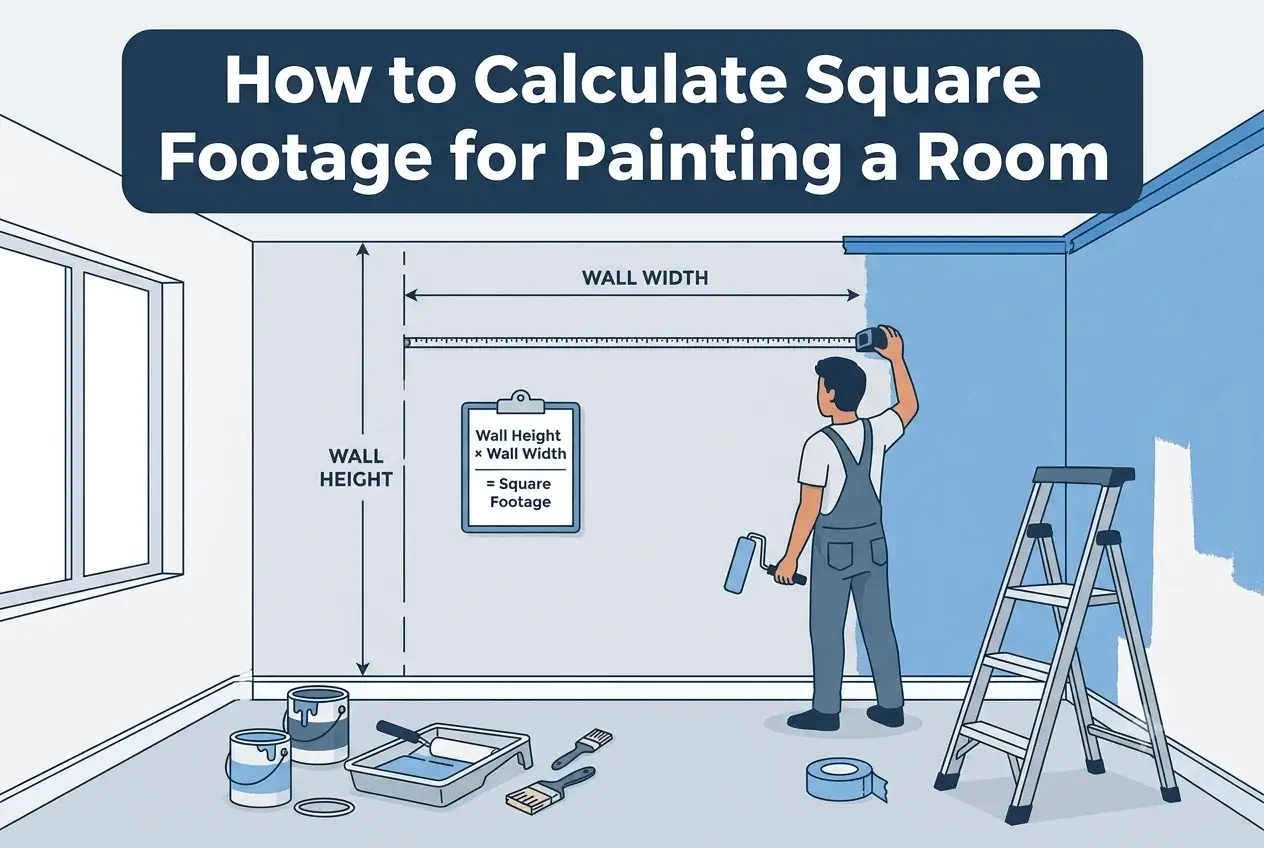
How to Calculate Square Footage for Painting a Room
Paint is sold by the gallon, covers a fixed number of square feet, and every wall has doors and windows eating into the total. Buy short and you’re stopping mid-wall to make an evening run to the store while a half-cut edge dries. Buy too much and you’re storing gallons of a custom tint you’ll never use again. Here’s how to land on the right number the first time.
- The formula
- Step-by-step process
- Paint coverage — gallons, quarts, and samples
- Same-color repaint
- Standard color change
- Dark-to-light or light-to-dark
- Bare drywall and new construction
- Ceiling paint — a separate calculation
- Worked examples by room
- Quick reference table
- Mistakes to avoid
- Frequently asked questions
Paint calculation runs on wall area, not floor area — that trips up more first-timers than anything else on this list. It also depends on something tile and flooring don’t have to worry about: how many coats your color needs, which changes with what’s already on the wall. This guide walks through both.
Have your room dimensions ready? Use SquareFootCalc.com to get the floor area in seconds — you’ll need it later for the ceiling.
The Formula
Round UP to the nearest whole gallon
Step-by-Step Process
Paint Coverage — Gallons, Quarts, and Samples
Coverage isn’t a fixed number — it moves with the paint’s formulation and what’s underneath it. Fresh drywall and textured walls soak up more paint per square foot than a smooth wall that’s already been painted once.
Same-Color Repaint
2 coats if you want fully even sheen and touch-up marks gone
This is the cheapest paint job you’ll ever calculate. The existing color is already doing most of the work — a single coat often looks complete, though most painters still do a second pass for an even sheen across the whole wall.
→ Buy 1 gallon
Standard Color Change
Skipping the second coat is the most common reason painters run out mid-project
The first coat covers the old color unevenly, especially near edges and corners where the roller doesn’t lay paint as thick. The second coat is what actually gives you a flat, uniform wall. Budget for it from the start rather than treating it as an “if needed.”
766 ÷ 350 = 2.19
→ Buy 3 gallons
Dark-to-Light or Light-to-Dark
A tinted primer under the new color often replaces one of those coats
Deep colors — navy, charcoal, forest green — need real pigment density to read as solid and even. Going the other way, covering a dark wall with white or a pale color, has the same problem in reverse: the dark base bleeds through two coats more often than not.
1,149 ÷ 350 = 3.28
→ Buy 4 gallons (or 1 gallon primer + 2 gallons paint)
Bare Drywall and New Construction
Followed by 2 coats of paint — 3 total layers
Raw drywall drinks paint unevenly — the joint compound over seams and screw holes absorbs more than the paper-faced board around it. Skip primer and you’ll see those patches as slightly different sheen for years. Primer seals the surface so the paint coats go on uniform.
Paint (2 coats): 700 ÷ 350 = 2 gallons
→ Buy 1 gallon primer + 2 gallons paint
Ceiling Paint — A Separate Calculation
Ceiling area comes from your floor’s length × width, not from the wall math above. It’s the same number as your room’s floor square footage.
Vaulted or sloped ceilings: measure the actual slope length, not the flat horizontal span — it’s larger than it looks from the floor plan
Ceiling paint is formulated to resist drips and hide imperfections in a flat, low-glare finish — it’s not the same product as wall paint even when the color looks similar on the shelf. Calculate and buy it separately, and don’t try to stretch your wall paint up onto the ceiling to save a trip to the store.
Worked Examples by Room
10×10 ft, 8 ft ceiling, 1 door, 1 window, 2 coats
14×12 ft, 9 ft ceiling, 2 doors, 3 windows, 2 coats
6×5 ft, 8 ft ceiling, 1 door, no windows, 2 coats
5 rooms, 210 linear ft of wall, dark-to-light, 3 coats
Quick Reference Table
| Room Size | Perimeter (approx.) | Wall Area (8 ft ceiling) | Gallons — 2 Coats, Avg. Openings |
|---|---|---|---|
| 8 × 8 ft | 32 ft | 256 sq ft | 1 gallon |
| 10 × 10 ft | 40 ft | 320 sq ft | 2 gallons |
| 12 × 10 ft | 44 ft | 352 sq ft | 2 gallons |
| 12 × 12 ft | 48 ft | 384 sq ft | 2 gallons |
| 14 × 12 ft | 52 ft | 468 sq ft | 3 gallons |
| 16 × 14 ft | 60 ft | 480 sq ft | 3 gallons |
Mistakes to Avoid
A 12×10 room’s floor is 120 sq ft. Its walls, at 8 ft tall, are 352 sq ft. Grab the wrong number and you’ll run out before the second wall is done.
Doors and windows aren’t getting painted. In a room with several of each, skipping this step overstates your need by 50 sq ft or more.
Almost every repaint needs two. Running out halfway through the second coat, with one wall lighter than the rest, is the single most common paint shortage.
The can’s coverage rating assumes a similar base color. Going from a dark wall to a pale one usually means a third coat or a tinted primer, whatever the label says.
Textured or heavily patched walls can drop coverage from 400 sq ft/gallon down to 250. If your walls aren’t smooth, calculate on the low end.
Save at least a quart, labeled with the date and room. Six months from now, matching that exact batch is the only way a touch-up won’t show.
Frequently Asked Questions
Most interior paint covers 350–400 sq ft per gallon on a single coat over a smooth, previously painted wall. Textured or porous surfaces can drop that to 250–300 sq ft. Check the coverage rating on your specific can — it varies by brand and formulation.
With an 8 ft ceiling: perimeter is 48 ft, gross wall area is 384 sq ft. Subtract a typical door and window (35 sq ft) for 349 sq ft net. At two coats, that’s 698 sq ft, which needs about 2 gallons at 350 sq ft/gallon coverage.
No. Ceiling area is your floor’s length × width — the same number as your floor square footage. Wall area uses perimeter × height instead. They’re different math and usually different paint products.
Round your gallon calculation up rather than buying a dedicated “extra” can on top of it. If you land close to a whole-gallon threshold, like 1.9 gallons, round up rather than trying to stretch a single gallon across the last wall.
Yes. Deep, saturated colors — navy, dark red, black — often need a third coat regardless of what’s underneath, because it takes more layers of pigment to reach full, even opacity. Budget for three coats on bold colors even over a similar shade.
Yes, whenever the wall needs it — bare drywall, stains, a major color change, or a switch in finish type. Primer uses the same net-wall-area math as paint but is a separate product and its own line on the shopping list.
Have your room dimensions? Get your wall area instantly.
Calculate Square Footage Free →
Who Luke?
Luke has spent years working around home renovation and construction projects, which is where his obsession with getting measurements right started. One wrong square footage estimate can mean hundreds of dollars wasted on flooring or materials — he learned that the hard way. These days he writes practical guides to help homeowners, renters, and DIYers measure accurately and confidently without needing a contractor to hold their hand.