How to Calculate Square Footage for Carpet
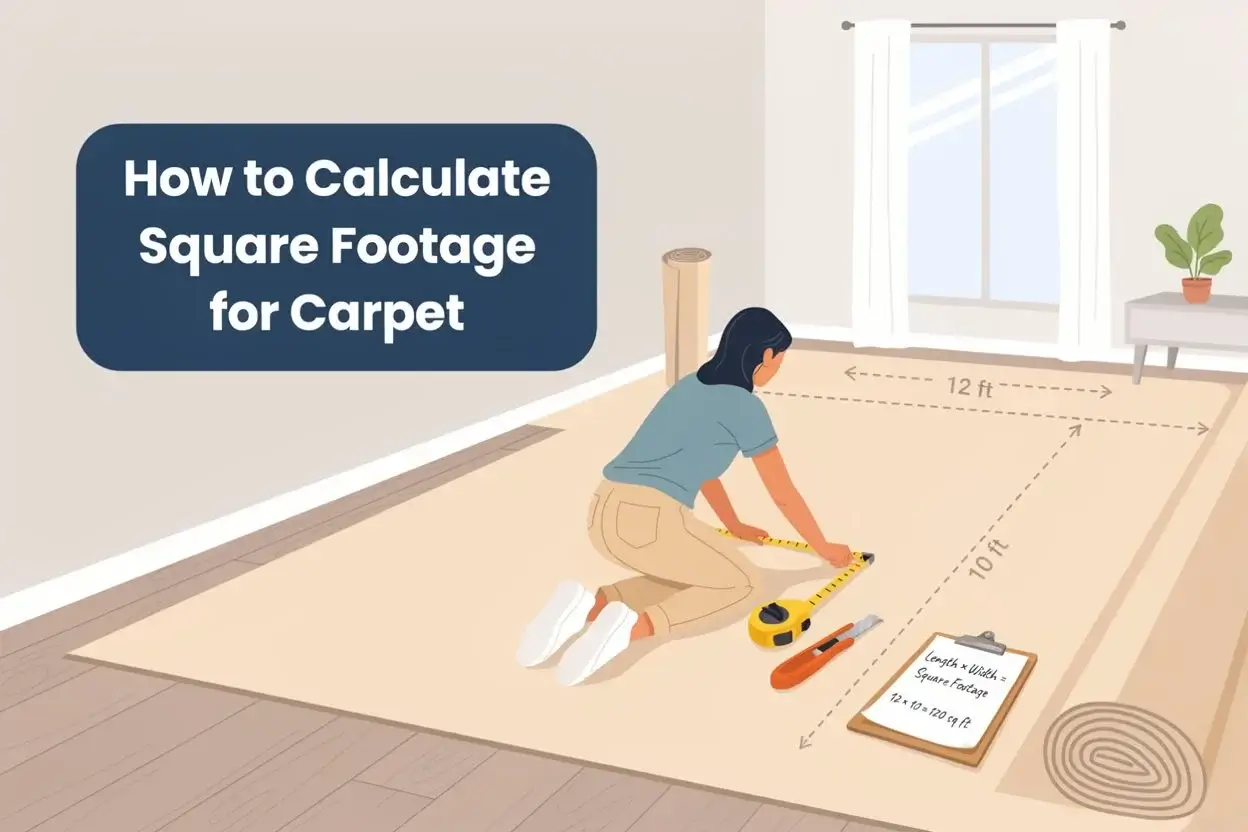
Carpet doesn’t come off the roll in neat room-sized rectangles. It comes in a fixed width — usually 12 feet — and any room wider than that needs a seam, which eats material fast. Order by square footage alone and you’ll come up short the moment your room doesn’t fit the roll cleanly. Here’s how installers actually work out the number.
Carpet is priced and ordered by the square yard, not the square foot, which is the first thing that trips people up. The second is roll width: a 12-foot-wide roll doesn’t care that your room is 12 feet 6 inches across — you’re paying for the full width either way, or you’re paying for a seam. This guide covers both.
Have your room dimensions ready? Use SquareFootCalc.com to get the square footage in seconds, then apply the waste factor and yard conversion from this guide.
The Formula
Round UP to the nearest yard, then check it against the roll width
Step-by-Step Process
Carpet Roll Widths and Why They Matter
Carpet doesn’t get cut to your room’s exact footprint the way a box of tile does. It comes off a fixed-width roll, and the installer works around that width — not the other way around. Knowing your roll width before you calculate tells you whether you’re paying for a clean single piece or an extra seam.
Simple Rectangular Rooms
12% if the room has a lot of closets, alcoves, or door thresholds to cut around
This is the easiest carpet order you’ll ever make. As long as the shorter wall stays under the roll width, the installer rolls out one piece, trims the edges, and you’re done. Waste here is just trim loss at the walls.
184.8 ÷ 9 = 20.5
→ Order 21 sq yd
L-Shaped and Irregular Rooms
20% for rooms with multiple offsets, angled walls, or bay windows
Split the room into rectangles, calculate each one’s square footage separately, then add them together before applying the waste factor. Irregular shapes waste more because the roll can’t follow an angled wall — every offset means another cut and another scrap piece too small to use elsewhere.
253 ÷ 9 = 28.1
→ Order 29 sq yd
Rooms Wider Than the Roll — Seaming
20–25% if the carpet has a repeating pattern that must align across the seam
A room wider than 12 feet in both directions needs two roll pieces joined at a seam. Solid or textured carpet hides a seam well with modest extra material. Patterned carpet is far less forgiving — the pattern repeat has to line up exactly, which means buying extra length just to get the alignment right.
257.6 ÷ 9 = 28.6
→ Order 29 sq yd
Stairs
Multiply by number of steps, then add 15% waste
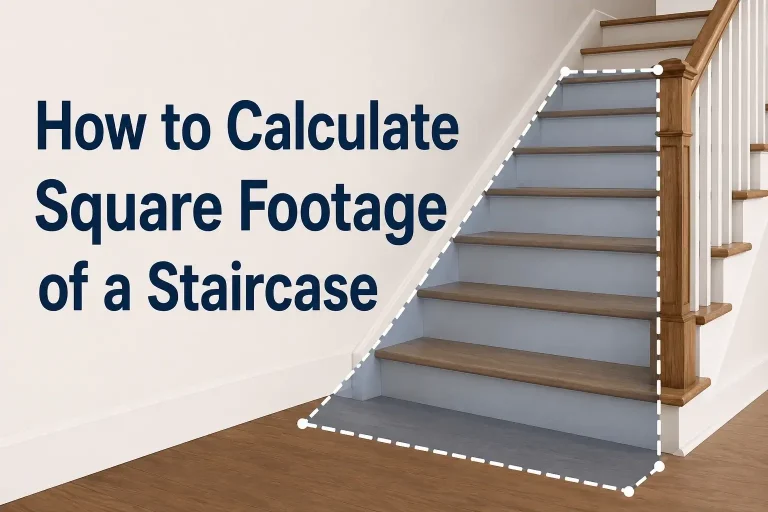
Stairs eat more carpet per square foot than any flat room because every tread and riser is a separate cut, and pile direction has to run the same way down the whole flight. Order one extra step’s worth of material beyond your calculation — installers use it to avoid seams on winder or landing steps.
4.5 × 14 = 63 sq ft × 1.15 = 72.5
→ Order 9 sq yd (round up, plus 1 extra step in reserve)
Carpet Padding — A Separate Calculation
Padding follows the same square footage as the carpet above it, but it’s ordered and priced separately — and unlike carpet, padding sheets can be turned to reduce waste on odd-shaped rooms.
Waste factor for padding is typically lower — 5–8% — since padding sheets can be rotated and pieced more freely than carpet
Padding that’s too thick under some carpet types voids the manufacturer’s warranty — plush and berber styles usually specify a maximum pad thickness. Check your carpet’s installation instructions before ordering padding, not after it’s already on the truck.
Worked Examples by Room
12×11 ft, simple rectangle, no seam
18×15 ft, one seam, textured carpet
12 steps, 36 in wide, standard tread/riser
4 bedrooms + hallway, ~950 sq ft, mixed shapes
Quick Reference Table
| Room Size | Sq Ft | Waste Factor | Square Yards to Order |
|---|---|---|---|
| 10 × 10 ft | 100 sq ft | 10% | 13 sq yd |
| 12 × 11 ft | 132 sq ft | 10% | 17 sq yd |
| 14 × 12 ft | 168 sq ft | 10% | 21 sq yd |
| 15 × 13 ft (near roll limit) | 195 sq ft | 15% | 25 sq yd |
| 18 × 15 ft (seamed) | 270 sq ft | 15% | 35 sq yd |
| L-shaped, 220 sq ft | 220 sq ft | 15–20% | 29–31 sq yd |
Mistakes to Avoid
Carpet is sold by the square yard. Order 185 when the store means 185 square yards, and you’ve ordered enough to carpet a small warehouse by mistake.
A room 12 ft 6 in wide still needs a full 12 ft roll plus a seamed strip — you can’t buy “half a roll’s worth” of width. Check your room against the roll before you calculate waste.
Patterned carpet needs extra length so the design lines up across a seam. Skipping this allowance is how installers end up with a visible mismatch down the middle of a room.
Stairs use tread + riser + overhang per step, not length × width. A flat-room calculation will always come up short on a staircase.
All carpet pieces in a room need to face the same direction, or the color will look different from one section to the next under changing light. This can force extra material even in a room that would otherwise need none wasted.
Closets get skipped constantly because they’re not part of the “room” in most people’s heads. Measure every closet floor separately and add it to the total before ordering.
Frequently Asked Questions
Divide your square footage by 9 — there are 9 square feet in a square yard. A 180 sq ft room needs 20 square yards of carpet before any waste factor is added.
12 × 12 = 144 sq ft. With 10% waste: 144 × 1.10 = 158.4 sq ft. Divide by 9: 17.6, which rounds up to 18 square yards.
Yes. Stairs are calculated per step — tread depth plus riser height plus a couple inches of overhang, multiplied by the stair width, then multiplied by the number of steps. Flat-room math (length × width) doesn’t apply to a staircase.
Add 20–25% instead of the standard 15% for a seamed room when the carpet has a repeating pattern. The extra material accounts for shifting the roll along its length until the pattern lines up across the seam.
Yes. Pile direction needs to run the same way throughout connected spaces, or the carpet will appear to be two different shades under normal lighting. This sometimes means buying from the same roll run in one continuous pull rather than piecing together leftover remnants.
Yes, always. Padding is a different product with its own square yard total, usually calculated with a smaller waste factor since pad sheets can be rotated and pieced more easily than carpet. Confirm the padding thickness matches what your carpet’s warranty allows before ordering.
Have your room dimensions? Get your carpet square footage instantly.
Calculate Square Footage Free →
Who Luke?
Luke has spent years working around home renovation and construction projects, which is where his obsession with getting measurements right started. One wrong square footage estimate can mean hundreds of dollars wasted on flooring or materials — he learned that the hard way. These days he writes practical guides to help homeowners, renters, and DIYers measure accurately and confidently without needing a contractor to hold their hand.