
How Much Flooring Do I Need? Square Footage Guide
You’ve measured the rooms. Now comes the decision that actually costs money — how many boxes to buy. Order too little and you stop mid-job waiting for a restock that may never come. Order too much and you’re storing boxes indefinitely. Here’s how to get it right.
This guide picks up where the measuring guide left off. If you don’t have your total square footage yet, start with SquareFootCalc.com to measure each room and add them up. Once you have that number, this guide tells you exactly how much flooring to buy.
From Square Footage to Order Quantity
Always round UP to the nearest whole box
→ Buy 24 boxes (or 25 to be safe)
Waste Factors Explained
Waste happens for three reasons: cuts at walls leave offcuts too short to reuse; doorways and transitions require additional cuts; and pattern matching on diagonal layouts wastes strips to align repeats. The more complex the installation, the higher the waste factor you need.
Hardwood, LVP, and Laminate
Round UP to whole boxes
528 ÷ 22 = 24.0 boxes
→ Buy 24 boxes
Box coverage varies by manufacturer and plank size. Always use the actual number from the product label — never a generic estimate. Wide-plank products often cover less per box than narrow-plank.
Tile — Floor and Wall
÷ sq ft per tile (or per box) = quantity
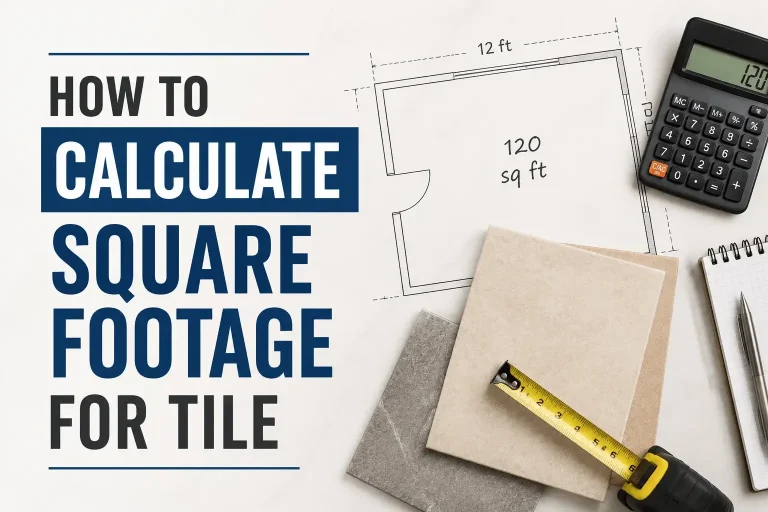
Each 12×12 tile = 1 sq ft
→ Buy 132 tiles (round up to full box)
Many outlets, corners, fixtures → 12%
Diagonal pattern → 15%
Mosaic or intricate pattern → 20%
Carpet
Carpet comes on rolls — typically 12 ft wide. If your room is wider than the roll, you need a seam. Most carpet is priced and sold per square yard, not square foot, so the final step is converting.
÷ 9 = square yards to order
Round UP to nearest yard
183 × 1.10 = 201.3 sq ft
201.3 ÷ 9 = 22.4 sq yards
→ Order 23 square yards
Quick Reference — All Flooring Types
| Flooring Type | Typical Waste | Sold In | Avg Coverage | Unit to Order |
|---|---|---|---|---|
| Hardwood (straight lay) | 10% | Boxes | 20–25 sq ft/box | Boxes (round up) |
| Hardwood (diagonal) | 15% | Boxes | 20–25 sq ft/box | Boxes (round up) |
| LVP / vinyl plank | 10% | Boxes | 20–30 sq ft/box | Boxes (round up) |
| Laminate (straight) | 10% | Boxes | 18–30 sq ft/box | Boxes (round up) |
| Laminate (diagonal) | 15% | Boxes | 18–30 sq ft/box | Boxes (round up) |
| Floor tile (straight) | 10% | Box or piece | Varies by size | Pieces (round up) |
| Floor tile (diagonal) | 15% | Box or piece | Varies by size | Pieces (round up) |
| Carpet | 10% | Square yards | Roll: 12 ft wide | Sq yards (round up) |
| Carpet (pattern) | 15–20% | Square yards | Roll: 12 ft wide | Sq yards (round up) |
How Flooring Boxes Work
Most hardwood, LVP, and laminate flooring is sold in cartons. Each carton contains a fixed number of planks that together cover a stated number of square feet — printed on the box label. This number varies by manufacturer and plank size, so always check the label before calculating.
If you need 24.1 boxes, buy 25. Flooring is sold in whole cartons. Rounding down guarantees you run short. You cannot buy a partial box at most retailers.
Box coverage varies by manufacturer, product, and plank width. A wide-plank floor may cover only 18 sq ft per box while a narrow-plank covers 28. Always read the actual label before calculating.
Dye Lots — Why Batch Matters
This is the detail most people learn the hard way. Flooring, tile, and carpet are manufactured in production batches — called dye lots or run numbers. Each batch has a slightly different colour, even when the product name and SKU are identical. The difference is invisible in the store but obvious once installed side by side on the floor.
The fix is simple: buy enough boxes from the same batch to complete the entire job in one purchase. Check that every box has the same lot number before accepting delivery. If you need to reorder later and the batch has changed, the new boxes may not match — and there’s nothing the retailer can do about it.
Buying Mistakes to Avoid
Your raw measurement is not your order quantity. Always add the waste factor before ordering. Skipping this step is the single most common reason jobs run short mid-installation.
If you need 14.3 boxes, you need 15. There is no such thing as 0.3 of a flooring box. Round every fractional result up — without exception.
Every box must have the same lot or run number. Check before you leave the store. Mixing lots creates a visible colour line that can’t be fixed without re-laying the entire floor.
Buy one extra box and store it. If a plank gets damaged six months later and the product is discontinued, that spare box saves you from a full floor replacement. The extra box is cheap insurance.
Diagonal and herringbone installations waste significantly more material at every corner and edge. Use 15% minimum for diagonal — using 10% will leave you short every time.
Box coverage varies by product. One manufacturer’s hardwood covers 22 sq ft per box; another’s covers 28. Always divide by the actual number on the product label — not a remembered figure from a previous project.
Frequently Asked Questions
Add 10% for straight-lay hardwood, LVP, or laminate in standard rooms. Add 12% if you have many doorways or an L-shaped layout. Add 15% for diagonal or herringbone patterns. For carpet, add 10% and convert the result to square yards. Always round up to the nearest whole box or yard.
Multiply your total room square footage by your waste factor (1.10 for standard, 1.15 for diagonal). Divide the result by the sq ft coverage stated on the box label. Round up to the nearest whole box. For example: 480 sq ft × 1.10 = 528 ÷ 22 sq ft per box = 24 boxes.
It varies by product. Most hardwood and LVP boxes cover 20–30 sq ft. Laminate typically covers 18–30 sq ft per box. Wide-plank products cover less per box than narrow-plank. Always check the actual label on the product you’re buying — never assume a standard coverage.
Divide square feet by 9. There are 9 square feet in one square yard. So 200 sq ft of carpet = 200 ÷ 9 = 22.2 square yards. Add your waste buffer before converting: 183 sq ft × 1.10 = 201.3 ÷ 9 = 22.4 → buy 23 square yards.
A dye lot (also called run number or batch number) identifies which production batch a flooring product came from. Each batch has a slightly different colour due to natural variation in materials and dyes. When you mix boxes from different lots, the colour difference is usually invisible in the box but visible once the planks are installed side by side. Always verify every box has the same lot number before buying.
Keep at least one box if you can. Leftover flooring from the same dye lot is invaluable for future repairs — replacing a damaged plank is only possible if you have matching material from the same batch. Check the retailer’s return policy before buying extra: most allow returns of unopened boxes within 30–90 days, so you can return surplus if you end up not needing it.
Know your sq ft? Calculate exactly how many boxes you need in seconds.
Calculate Square Footage Free →
Who Luke?
Luke has spent years working around home renovation and construction projects, which is where his obsession with getting measurements right started. One wrong square footage estimate can mean hundreds of dollars wasted on flooring or materials — he learned that the hard way. These days he writes practical guides to help homeowners, renters, and DIYers measure accurately and confidently without needing a contractor to hold their hand.