How to Measure Square Feet Without a Tape Measure
Your tape measure is in the car, or you forgot it entirely, or you’re just trying to get a quick sense of a room before committing to anything. Here are six reliable methods that actually work.
No tape measure doesn’t mean no measurement. People have been estimating room sizes long before tape measures existed — using paces, body lengths, and known objects as references. Most of these methods get you within 5–10% of the real number, which is close enough for furniture shopping, paint estimates, and renovation quotes.
For exact square footage — flooring, tiling, or anything you’re buying by the box — always come back and measure with a tape measure or use our free Square Foot Calculator once you have one. But for everything else, here’s what works.
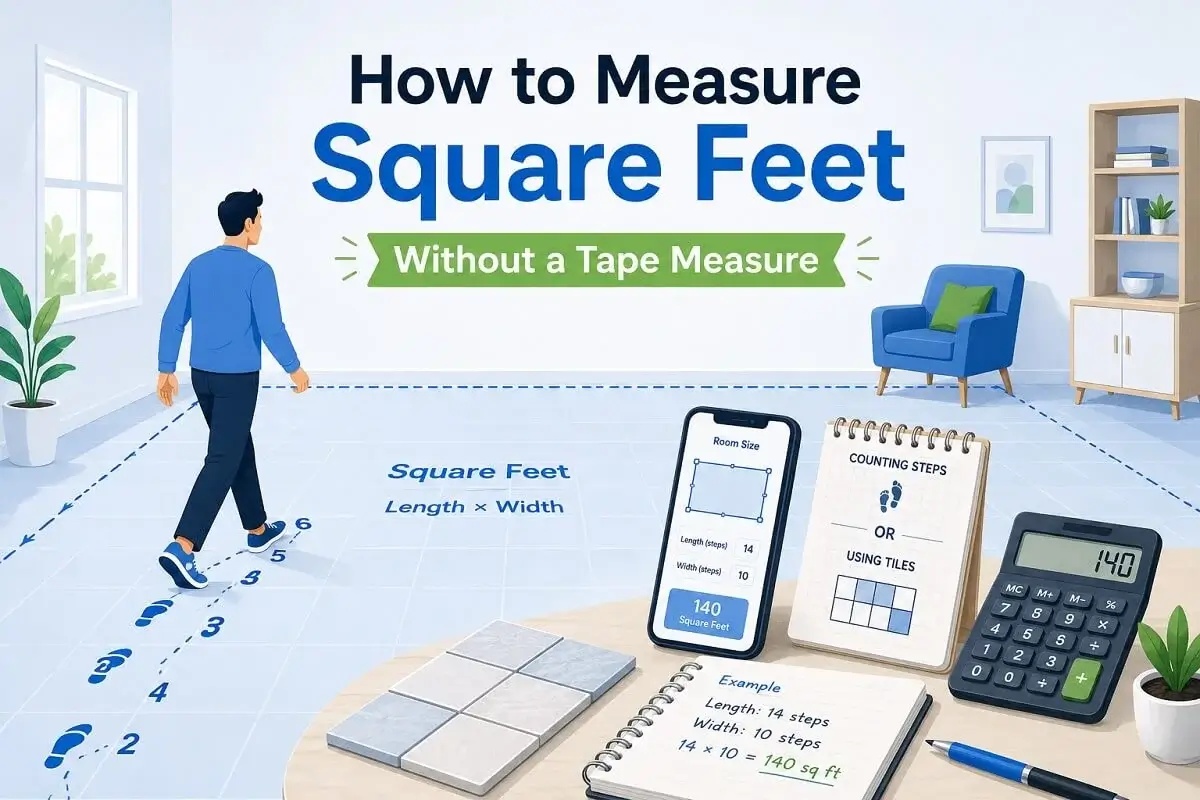
Walking Heel-to-Toe
Width: 10 steps × 1 ft = 10 ft
12 × 10 = ~120 sq ft
Using Your Body as a Ruler
Before smartphones, builders used body measurements for centuries. Yours are always with you — you just need to know them.
Counting Standard Objects
If the room has things with known measurements — floor tiles, ceiling tiles, a standard doorway — count them and multiply.
| Object | Known Size |
|---|---|
| Standard interior door width | 30–32 inches |
| Standard door height | 6 ft 8 in (80 in) |
| Floor tile (common) | 12×12 in or 18×18 in |
| Ceiling tile (drop ceiling) | 2 ft × 2 ft or 2 ft × 4 ft |
| Standard brick | 7.5 in long × 2.25 in tall |
| Standard sheet of drywall | 4 ft × 8 ft |
| Kitchen base cabinet (single) | 12 in deep × 24 in wide |
Each tile = 12 in = 1 ft
15 × 12 = 180 sq ft
Smartphone Measurement Apps
Modern phones have sensors that can measure rooms with surprising accuracy. The best options:
One caveat: apps are less accurate in dark rooms, very small spaces, or rooms with mirrors and glass surfaces that confuse the sensor.
Floor Plans and Property Records
If you’re measuring a room in a home you own or are considering buying, the dimensions may already exist somewhere:
Records may not reflect additions or renovations done after the last assessment. Treat them as a reliable starting point, not a guaranteed exact figure.
The String Method
23 × 6.14 in = 141.2 in ÷ 12 = 11.76 ft
String for width = 18 dollar bills
18 × 6.14 in = 110.5 in ÷ 12 = 9.21 ft
11.76 × 9.21 = ~108 sq ft
Accuracy Comparison at a Glance
| Method | Typical Accuracy | Best Used For | Equipment Needed |
|---|---|---|---|
| Smartphone app (LiDAR) | 1–3% | Most reliable no-tape option | iPhone 12 Pro or newer |
| Floor / property records | 1–5% | Existing homes you can look up | Internet access |
| Walking heel-to-toe | 3–5% | Any room, no equipment | Just your feet |
| String method | 3–6% | When walking isn’t practical | String + known object |
| Counting objects (tiles etc.) | 5–8% | Rooms with identifiable standard items | Nothing |
| Body measurements | 5–10% | Awkward spaces, quick estimates | Nothing |
Tips for Getting Closer
Walk or string every dimension twice. If you get different results, take the average. One distracted count can easily be off by a full step.
Don’t hold step counts in your head while you walk the next wall. Write the first dimension down before you start the second.
For body-based methods, always measure your foot, stride, or forearm against something known before using it in an unfamiliar room.
If your estimate is off by even 5%, that’s a box of flooring you’re short. Add 15% instead of 10% when working from an estimated measurement.
A standard interior doorway is 6 ft 8 in tall and 30–32 in wide. Count door-widths along a wall as a quick sanity check on your step count.
If your phone has ARCore or LiDAR, use it to confirm your walked estimate. Ten seconds of pointing gets you a second data point to compare against.
These methods are fine for furniture shopping, rough renovation quotes, and paint estimates. For anything where being off by 5% costs money — flooring, tile, carpet, hardwood — always come back and measure properly before you buy. A tape measure costs less than one wrong box of tile.
Frequently Asked Questions
Within 3–5% when done carefully — meaning if the room is actually 150 sq ft, you’ll get somewhere between 142 and 158 sq ft. That’s accurate enough for furniture planning and rough paint estimates, but not precise enough for buying flooring by the box.
For a rough estimate, yes — especially if you have an iPhone Pro with LiDAR, which gets within 1–2 inches. But for final material purchase, it’s still better to verify with a tape measure. Flooring is sold by the box and you can’t return a partial box — getting the number exactly right saves money.
Walking heel-to-toe carefully — especially if you calibrate your pace first using a known distance in the same room, like a standard door height (6 ft 8 in). Walk it twice and average your step counts.
Yes. Split the room into rectangles the same way you would with a tape measure — sketch the shape, divide it into sections, measure each section using whichever method you’re using, calculate area for each section, then add them together.
Yes — a US dollar bill is exactly 6.14 inches (15.6 cm) long and 2.61 inches (6.63 cm) wide. These dimensions haven’t changed since 1928. For a rough room estimate, laying dollar bills end-to-end along a string works surprisingly well.
You can, but stride length varies much more than foot length, especially on short distances where you’re changing pace to fit the wall. Heel-to-toe is more consistent and easier to control — one step always equals one foot length regardless of how fast you’re walking.
Got your estimated dimensions? Calculate the exact square footage in seconds.
Calculate Square Footage Free →
Who Luke?
Luke has spent years working around home renovation and construction projects, which is where his obsession with getting measurements right started. One wrong square footage estimate can mean hundreds of dollars wasted on flooring or materials — he learned that the hard way. These days he writes practical guides to help homeowners, renters, and DIYers measure accurately and confidently without needing a contractor to hold their hand.