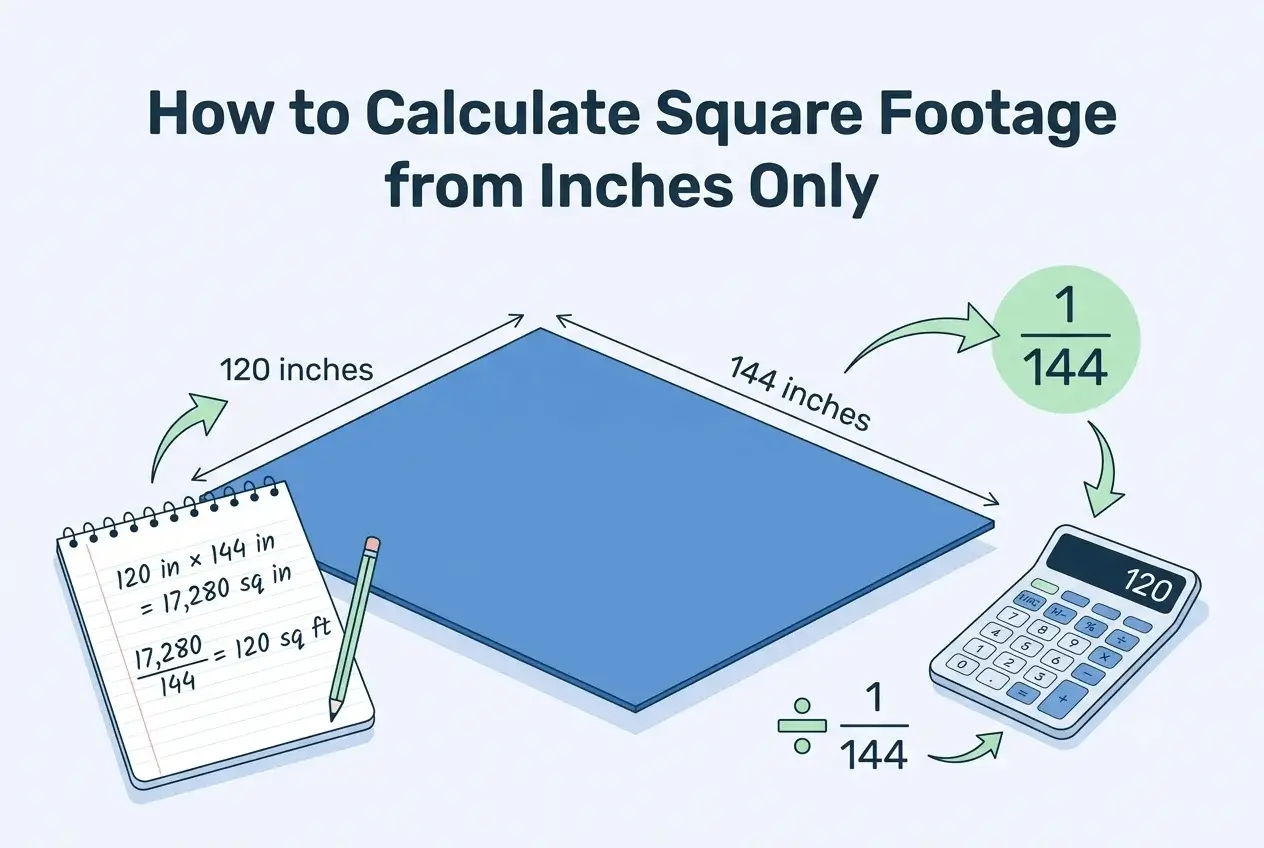
How to Calculate Square Footage from Inches Only
Sometimes your tape measure gives you everything in inches — or it’s just easier to measure that way. Here’s exactly how to convert those inch measurements into square footage without getting confused mid-calculation.
Measuring in inches only is more common than people think — small rooms, tile jobs, and anyone who finds it easier to call everything out in one unit end up with two numbers like 126 inches × 108 inches. The math to get to square feet from there is simple, but there’s one step people consistently skip and it throws off the whole calculation.
Want to skip the math entirely? Enter your inch measurements directly into SquareFootCalc.com and get the square footage instantly.
Why Measure in Inches Only?
There are a few situations where measuring everything in inches — rather than feet and inches — makes life easier:
Backsplashes, bathroom floors, and window areas are often small enough that working in inches throughout is cleaner than switching between feet and inches constantly.
Architectural drawings sometimes list dimensions in total inches. Knowing how to work with those directly saves you from converting to feet first.
Tile, flooring planks, and carpet rolls are often listed in inch dimensions. Measuring in inches lets you compare directly without converting.
Some people find it easier to work with whole numbers like 126 × 108 rather than mixed numbers like 10 ft 6 in × 9 ft. Both give the same answer.
The Formula
There are 144 square inches in one square foot — because 12 inches × 12 inches = 144 square inches. That’s the only conversion factor you need.
Step-by-Step: A Real Example
Let’s measure a bedroom that’s 126 inches long × 108 inches wide.
The most common mistake is multiplying the inch measurements and thinking you have square feet. You don’t — you have square inches, which are 144 times smaller. Always divide by 144 at the end. Forgetting this step turns a 94 sq ft room into a phantom 13,608 sq ft mansion.
Two Methods — Same Answer
There are two valid approaches to this calculation. Pick whichever is easier to follow for how your brain works.
Multiply Inches → Divide by 144
Multiply both inch measurements together first, then divide the result by 144 once at the end.
13,608 ÷ 144 = 94.5 sq ft
Best for: one calculation at the end — fewer steps overall.
Convert to Feet → Multiply
Divide each inch measurement by 12 to convert to feet first, then multiply the two foot values together.
108 ÷ 12 = 9 ft
10.5 × 9 = 94.5 sq ft
Best for: when you want to see the foot dimensions clearly.
Both methods give exactly the same answer every time. Method 1 is slightly faster. Method 2 gives you the room dimensions in feet as a bonus, which is useful if you need to describe the room size to someone.
More Worked Examples
Living Room: 180 in × 156 in
Equivalent to 15 ft × 13 ft — a decent-sized living room.
Bathroom: 90 in × 72 in
Equivalent to 7.5 ft × 6 ft — a standard bathroom.
Kitchen: 144 in × 120 in
Equivalent to 12 ft × 10 ft — a standard kitchen.
Small Bedroom: 114 in × 102 in
Equivalent to 9.5 ft × 8.5 ft — a compact single bedroom.
Quick Reference Table
Common room sizes in inches with their square footage already calculated:
| Inches (L × W) | Feet (L × W) | Square Footage | Typical Room |
|---|---|---|---|
| 96 × 96 in | 8 × 8 ft | 64 sq ft | Very small room / closet |
| 120 × 120 in | 10 × 10 ft | 100 sq ft | Small bedroom / office |
| 120 × 144 in | 10 × 12 ft | 120 sq ft | Average bedroom |
| 144 × 144 in | 12 × 12 ft | 144 sq ft | Standard bedroom |
| 144 × 180 in | 12 × 15 ft | 180 sq ft | Large bedroom |
| 168 × 192 in | 14 × 16 ft | 224 sq ft | Master bedroom |
| 180 × 180 in | 15 × 15 ft | 225 sq ft | Medium living room |
| 192 × 240 in | 16 × 20 ft | 320 sq ft | Large living room |
Irregular Rooms in Inches
L-shaped rooms and rooms with alcoves or bump-outs work exactly the same way — split into sections, calculate each one in inches, divide each by 144, then add the square footage totals together.
Mistakes to Avoid
The single most common error. Multiplying inches gives you square inches — you must divide by 144 to get square feet. A 94 sq ft room has 13,608 square inches — very different numbers.
Dividing by 12 converts inches to feet — but you need to do that to both measurements. Dividing the final product by 12 only is wrong. Always divide the inch product by 144 (which is 12 × 12).
If one wall is in inches and the other accidentally ends up in feet, your result will be meaningless. Commit to one unit throughout — then convert at the very end.
After converting to square feet, still add 10% for flooring cuts and waste. The conversion method doesn’t change how much material you actually need to buy.
Frequently Asked Questions
Because you’re converting square inches to square feet, not linear inches to linear feet. One square foot is 12 inches × 12 inches = 144 square inches. When you multiply two inch measurements together, you get square inches — so you need to divide by 144 to get square feet. Dividing by 12 only converts one dimension, not both.
120 × 144 = 17,280 square inches. 17,280 ÷ 144 = 120 square feet. That’s the same as a 10 ft × 12 ft room.
Yes — that’s Method 2 above and it gives the same answer. Divide each inch measurement by 12 to get feet, then multiply length × width. Both methods are equally correct.
Use the decimal as-is. 126.5 × 108 = 13,662 ÷ 144 = 94.9 sq ft. The formula handles decimals the same way as whole numbers — just multiply and divide.
Not more accurate — but for small rooms or areas where inch-level precision matters (tile work, small bathrooms), measuring in total inches avoids the step of converting feet and inches to decimal feet. The precision of the result depends on how carefully you measure, not on which unit you use.
144 square inches. A square foot is a 12-inch × 12-inch square, and 12 × 12 = 144. That’s the number you always divide by when converting square inches to square feet.
Have your inch measurements ready? Skip the math and get your square footage instantly.
Calculate Square Footage Free →
Who Luke?
Luke has spent years working around home renovation and construction projects, which is where his obsession with getting measurements right started. One wrong square footage estimate can mean hundreds of dollars wasted on flooring or materials — he learned that the hard way. These days he writes practical guides to help homeowners, renters, and DIYers measure accurately and confidently without needing a contractor to hold their hand.