How to Calculate Square Feet When Your Measurements Include Inches
Most rooms aren’t exactly 10 × 12. They’re 10 ft 6 in × 12 ft 3 in. That half-foot doesn’t sound like much — until you’re at the flooring store trying to figure out how many boxes to buy.
Square footage is just area — length times width. The only wrinkle is that your tape measure gives you feet and inches, and you need everything in the same unit before you multiply. This guide shows you exactly how to do that, with two different methods and several worked examples.
In a hurry? Plug your measurements straight into SquareFootCalc.com — it handles feet and inches automatically.
The Core Idea
Your tape measure shows you feet and inches — like 10 ft 6 in. To multiply two measurements together, you need them both in the same unit. The simplest way is converting everything to decimal feet, where 6 inches becomes 0.5 feet and 9 inches becomes 0.75 feet. Then you multiply as normal.
Step 2 — Multiply length × width
Step-by-Step: A Real Example
Let’s work through a room that measures 10 ft 6 in × 12 ft 3 in.
3 inches ÷ 12 = 0.25 → so 12 ft 3 in becomes 12.25 ft
Two Methods — Pick Whichever Feels Easier
There’s more than one way to handle feet and inches. Both give you the exact same answer. Pick whichever feels less error-prone for how your brain works.
Convert to Decimal Feet
Divide the inch portion by 12, add it to the feet, then multiply.
= 128.63 sq ft
Best for: anyone comfortable with decimals. Most calculators use this format.
Convert Everything to Inches
Multiply feet × 12 and add the inches, multiply both together, then divide by 144.
→ 18,522 ÷ 144
= 128.63 sq ft
Best for: anyone who hates decimals and prefers whole numbers throughout.
Both methods give the same result. Method 1 is faster. Method 2 avoids decimals mid-calculation. There’s no wrong answer — use whatever you’re less likely to make a mistake with.
Inches-to-Decimal-Feet Reference
You’ll use these same conversions over and over. Bookmark this table or take a photo of it before your next measuring job.
| Inches | Decimal Feet | Easy to Remember As |
|---|---|---|
| 1 in | 0.08 ft | — |
| 2 in | 0.17 ft | — |
| 3 in | 0.25 ft | Quarter foot |
| 4 in | 0.33 ft | Third of a foot |
| 5 in | 0.42 ft | — |
| 6 in | 0.50 ft | Half foot |
| 7 in | 0.58 ft | — |
| 8 in | 0.67 ft | Two thirds of a foot |
| 9 in | 0.75 ft | Three quarter foot |
| 10 in | 0.83 ft | — |
| 11 in | 0.92 ft | — |
| 12 in | 1.00 ft | One full foot |
More Worked Examples
Here are two more rooms worked through from start to finish — a bedroom and a small bathroom, which are two of the most common rooms people measure.
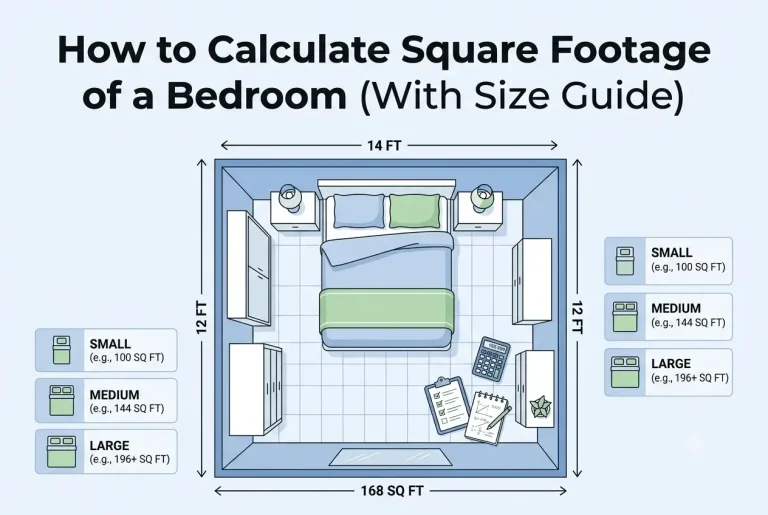
Bedroom: 11 ft 8 in × 13 ft 4 in
A comfortable double bedroom — enough for a queen bed with room to spare.
Bathroom: 8 ft 6 in × 5 ft 9 in
A standard bathroom — tight enough that tile layout matters.
L-Shaped and Irregular Rooms
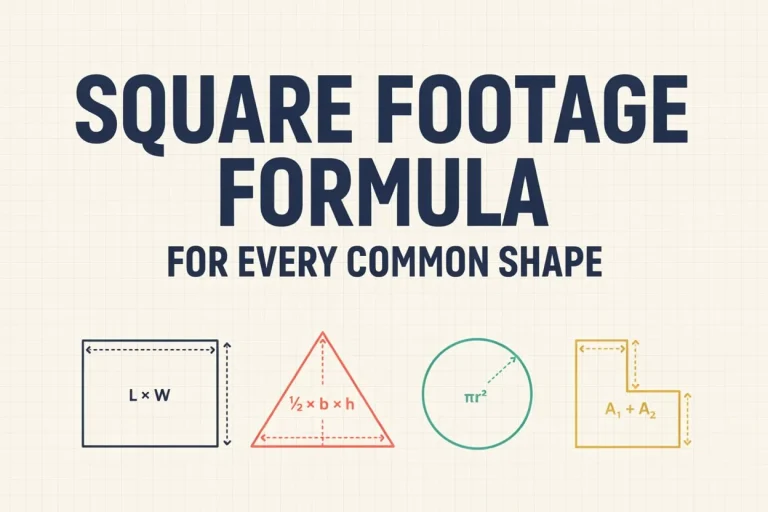
When a room isn’t a rectangle, split it into sections, calculate each one, then add them together. The same feet-and-inches method applies to each section individually.
L-Shaped Room with Mixed Measurements
Section A has a mixed measurement (10 ft 6 in), so convert that first: 10 ft 6 in = 10.5 ft. Section B is clean feet — no conversion needed. Calculate each section, then add.
Section B: 4 × 6 = 24 sq ft
84 + 24 = 108 sq ft
Key rule: sections must not overlap, and together they must cover the entire floor. Sketch the room first to make sure you haven’t missed any corner.
How Much Material to Buy
Raw square footage is your floor area. For flooring, tile, or carpet, you need to add a waste factor for cuts, offcuts, and the occasional mistake. How much you add depends on the job:
→ Buy material for 142 sq ft (round up to full boxes)
Always round up to full boxes — most flooring is sold in cartons and you can’t buy half a box. Running short mid-project means a second trip and a possible dye lot mismatch that won’t match your existing floor. Buy a little extra and keep a box in reserve for future repairs.
Mistakes Worth Avoiding
10 ft 6 in is not 10 feet. On a typical bedroom, ignoring the inch portions can throw your total off by 10–15 sq ft — enough to run short on flooring.
Do your math with the full decimal value (e.g. 0.667), then round only the final answer. Rounding 8 inches to 0.7 ft instead of 0.667 ft compounds the error over a full room.
Walls aren’t always perfectly parallel — especially in older homes. Measure at both ends of the room and use the larger number to be safe.
If you’re buying flooring, closet floors need it too. Measure them separately and add them in — a 3 × 5 closet is 15 sq ft you’d otherwise miss.
Always add 5–15% for waste. Running exactly the right amount guarantees you’ll be one cut short. Buy extra — leftover flooring is a good thing to have around for repairs.
Pick one method — decimal feet or whole inches — and stick with it for the whole calculation. Switching partway through is an easy way to introduce errors.
Frequently Asked Questions
10.5 feet. Divide the 6 inches by 12 to get 0.5, then add it to 10. The pattern works for any measurement: take the inch portion, divide by 12, add the result to the feet.
Yes — most phone calculators handle this easily. Type in the foot portion, press +, then type the inch portion ÷ 12, hit =. You’ll get your decimal feet. Or use SquareFootCalc.com, which accepts feet and inches directly without any manual conversion.
Yes — that’s Method 2 above. Convert both measurements entirely to inches (feet × 12 + inches), multiply them together, then divide by 144. For a 10 ft 6 in × 12 ft 3 in room: 126 × 147 = 18,522 ÷ 144 = 128.6 sq ft. Same result, no decimals involved.
110.25 square feet. Convert both dimensions: 10.5 ft × 10.5 ft = 110.25 sq ft.
For flooring and material purchases, the nearest half-inch (0.04 ft) is more than precise enough. Round your final answer to one decimal place — so 128.63 sq ft becomes 128.6 sq ft. Then add your waste buffer and round up to the next whole number when buying boxes.
Convert the fraction to inches first, then divide by 12. ½ inch = 0.5 inches ÷ 12 = 0.042 ft. ¾ inch = 0.75 inches ÷ 12 = 0.063 ft. In practice, measurements under 1 inch rarely affect your material purchase — focus on getting the feet and whole-inch portions right.
Don’t want to do the conversion by hand? Enter feet and inches directly and get your answer instantly.
Calculate Square Footage Free →
Who Luke?
Luke has spent years working around home renovation and construction projects, which is where his obsession with getting measurements right started. One wrong square footage estimate can mean hundreds of dollars wasted on flooring or materials — he learned that the hard way. These days he writes practical guides to help homeowners, renters, and DIYers measure accurately and confidently without needing a contractor to hold their hand.